

A common myth plagues many D2C brands: “If we can just increase our traffic, we’ll see more sales.” While increasing traffic can help, it’s not the ultimate fix. Without knowing how to convert visitors, you’ll just be cycling through users rather than building a loyal customer base. Let’s explore this myth and understand the reality.
Many Direct-to-Consumer (D2C) brands mistakenly focus solely on driving more traffic to their websites, believing it will directly increase revenue. However, the core issue for most isn’t a lack of visitors, but rather an inability to effectively convert that existing traffic into paying customers, highlighting a critical sales conversion challenge and a common D2C pitfall.
The real growth engine lies in optimizing the customer journey to turn casual browsers into serious buyers.
Let’s understand the myth of traffic and explore the probabilities of conversion.
Key Takeaways
- Traffic is Often a Red Herring: Many D2C brands already attract sufficient visitors; the problem is their website isn’t converting enough of them into buyers.
- Conversion Rate is King: A higher conversion rate means more sales from the same amount of traffic, leading to better ROI on marketing spend.
- User Experience (UX) is Crucial: A seamless, intuitive, and trustworthy website experience is fundamental for successful sales conversion, especially for customers in emerging markets.
- Trust Builds Sales: Clear trust signals, easy returns, and transparent information are vital for consumers to overcome skepticism and complete purchases.
- Data-Driven Decisions: Regularly reviewing various metrics like cart abandonment and average order value, not just traffic, assists in pinpointing and resolving obstacles to conversion.
- Personalization Matters: Tailoring content and offers to different customer segments can significantly boost conversion rates.
- Mobile-First Approach: With a vast majority of internet users accessing via mobile, an optimized mobile experience isn’t optional; it’s essential for D2C challenges.
- Payment Gateway Optimization: Offering a variety of secure, convenient, and locally relevant payment options (UPI, COD, and net banking) is non-negotiable for improving online sales conversion.
The Traffic Misconception: Why More Eyeballs Don’t Always Mean More Sales
Many D2C entrepreneurs, especially those starting out in Tier 2 and Tier 3 cities in India, often believe that simply attracting more visitors to their website will solve all their revenue problems. This is a common misconception because while traffic is necessary, it’s the effectiveness of converting that traffic into paying customers that truly drives growth and addresses core D2C challenges.
Consider a bustling market in Lucknow or Jaipur. A shopkeeper might attract hundreds of passersby with a grand display, but if their pricing is confusing, the products are not clearly visible, or the salesperson is unhelpful, few will make a purchase. The same principle applies online. In 2026, with digital ad costs continually rising, blindly chasing traffic without optimizing for conversion is like pouring water into a leaky bucket – you’re spending money only to lose potential sales.
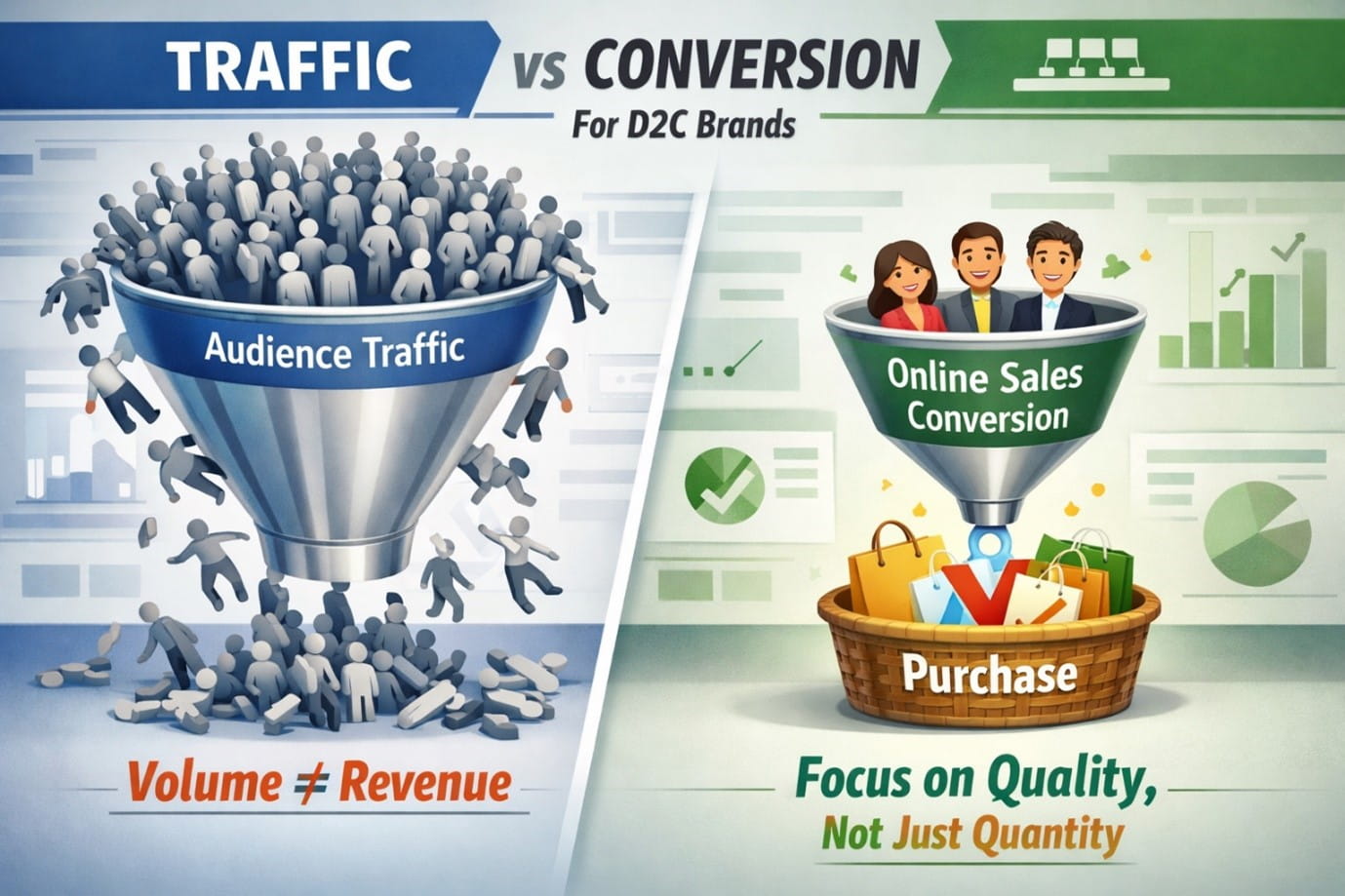
Having many visitors on your website is pointless if they leave without making a purchase or adding items to their cart. This isn’t just about losing individual sales; it impacts your marketing ROI, brand perception, and long-term sustainability. My friend, Rohit, who runs a D2C brand selling handcrafted leather goods from Agra, initially focused heavily on Instagram ads to drive traffic. He saw impressive visitor numbers, but his sales remained stagnant. It was only when he shifted his focus to understanding why people weren’t buying that his business truly began to flourish.
Understanding Conversion vs. Traffic: The Core of Online Sales Conversion
The difference between conversion and traffic is fundamental: traffic refers to the number of visitors your website receives, while conversion is the percentage of those visitors who complete a desired action, such as making a purchase, signing up for a newsletter, or downloading an app. For D2C brands, the primary desired action is typically a sales conversion.
Let’s break it down:
- Audience Traffic: This is your reach. It’s about getting people to your digital storefront. Metrics like website visits, unique users, page views, and impressions fall under this. Tools like Google Analytics track this.
- Sales Conversion: This is your impact. It’s about turning those visitors into customers. Your conversion rate is calculated as (Number of Sales / Number of Visitors) x 100. If 100 people visit your site and 2 make a purchase, your conversion rate is 2%.
Imagine you have two D2C brands, both selling organic spices sourced from Kerala, targeting consumers across India.
Metric | Brand A (Traffic-Focused) | Brand B (Conversion-Focused) |
Monthly Website Traffic | 50,000 visitors | 25,000 visitors |
Monthly Sales | 500 orders | 750 orders |
Conversion Rate | 1% (500/50,000) | 3% (750/25,000) |
Ad Spend (per visitor) | ₹5 | ₹5 |
Ad Cost | ₹250,000 | ₹125,000 |
Revenue (Avg. Order ₹500) | ₹250,000 | ₹375,000 |
Profit Before COGS | ₹0 (₹250k revenue – ₹250k ad cost) | ₹250,000 (₹375k revenue – ₹125k ad cost) |
Brand B, despite having half the traffic, generates more sales and significantly higher profit simply because it excels at sales conversion. This example clearly illustrates that optimizing your conversion rate is often a more cost-effective and profitable strategy than endlessly chasing more traffic. It addresses the fundamental D2C challenges of profitability and sustainable growth.
Strategies to Boost Conversions: Turning Browsers into Buyers
To effectively tackle D2C challenges and improve sales conversion, D2C brands need a multi-faceted approach focusing on the entire customer journey. This isn’t just about tweaking a button; it’s about building trust, providing clarity, and simplifying the path to purchase.
Optimize Your Website User Experience (UX)
A smooth, intuitive, and enjoyable website experience is paramount. Customers, especially those in Tier 2 and Tier 3 cities who might be newer to extensive online shopping, need clarity and ease.
- Mobile-First Design: Over 80% of internet users in India access the internet via mobile (IAMAI & Kantar, 2023). Your website must be flawlessly responsive and fast on mobile devices. My friend’s cousin, who runs a D2C saree brand from Varanasi, noticed a significant drop in cart abandonment after optimizing her site for mobile, making product images load faster and text easier to read on smaller screens.
- Clear Navigation: Users should be able to find what they’re looking for within a few clicks. Use logical categories, a prominent search bar, and breadcrumbs.
- High-Quality Product Images & Videos: Since customers can’t physically touch your products, invest in professional, high-resolution images from multiple angles. Videos demonstrating usage, especially for products like cosmetics or home goods, can significantly reduce uncertainty.
- Detailed Product Descriptions: Go beyond features. Explain benefits, materials (e.g., ‘100% organic cotton sourced from farmers in Gujarat’), usage instructions, and care guides. For fashion, include size charts with measurements in CM.
- Fast Loading Speed: Slow websites frustrate users and increase bounce rates. Optimize images, leverage caching, and choose a reliable hosting provider.
Build Trust and Credibility
Trust is the currency of online commerce, especially for new or lesser-known D2C brands in India. Without it, conversions will suffer.
- Customer Reviews & Testimonials: Display authentic reviews prominently. Encourage customers to leave reviews, perhaps with a post-purchase email sequence. A D2C brand selling traditional snacks from Hyderabad saw a 15% jump in conversion after integrating user-generated content and video testimonials from satisfied customers.
- Clear Policies: Transparent shipping, return, refund, and privacy policies are non-negotiable. Make them easy to find and understand.
- Secure Payment Options: Offer widely trusted payment gateways. In India, this means supporting UPI (BHIM, Google Pay, PhonePe), net banking, debit/credit cards, and Cash-on-Delivery (COD). A lack of preferred payment options is a major conversion killer.
- Trust Badges & Certifications: Display logos of secure payment gateways (e.g., Razorpay, PayU), security certificates (SSL), or any relevant industry certifications (e.g., ‘Organic India Certified’).
- Responsive Customer Support: Provide multiple channels for support (WhatsApp, chat, phone, and email) and respond promptly. This signals reliability.
Streamline the Checkout Process
The checkout flow is where many potential sales conversions are lost. Simplify it as much as possible.
- Guest Checkout Option: Don’t force users to create an account. While account creation can offer benefits, it introduces friction at the critical conversion stage. Offer it as an option after purchase.
- Minimize Form Fields: Only ask for essential information. Each additional field can reduce completion rates.
- Progress Indicator: Let users know where they are in the checkout process (e.g., “Step 1 of 3”).
- Save Cart Functionality: Allow users to save their cart for later, especially if they abandon it.
- Clear Call-to-Actions (CTAs): Use compelling and action-oriented language for buttons like “Add to Cart,” “Buy Now,” or “Complete Purchase.” Make them visually prominent.
Compelling Offers and Urgency
Sometimes, a gentle nudge or an attractive incentive is all it takes to push a hesitant buyer towards successful conversion.
- First-Time Buyer Discounts: Offer a small discount for signing up for your newsletter or for their first purchase.
- Limited-Time Offers: Create a sense of urgency with flash sales or expiring discounts. “Offer ends tonight!” can be very effective.
- Free Shipping (especially above a certain threshold): In India, free shipping is a significant motivator. Consider offering it above a particular order value to also increase Average Order Value (AOV).
- Bundle Deals: Offer product bundles at a slightly reduced price to encourage larger purchases. For instance, a D2C coffee brand might offer a grinder + coffee bean bundle.
- Exit-Intent Pop-ups: When a user is about to leave, trigger a pop-up with a special offer or a reminder about their cart.
Leverage Personalization
Generic experiences yield generic results. Tailor the shopping experience to individual users.
- Product Recommendations: Use AI-driven recommendations based on browsing history, purchase behavior, or popular items (e.g., “Customers who bought this also bought…”).
- Personalized Email Marketing: Segment your email list and send targeted promotions. If someone viewed a particular product but didn’t buy, send them a reminder or a related offer.
- Dynamic Content: Adjust website content (e.g., homepage banners, product showcases) based on the user’s location, past interactions, or demographics.
My personal experience with a D2C organic food brand based out of Bengaluru taught me the power of personalization. We started segmenting our email list based on dietary preferences (vegan, gluten-free) and location and sending tailored recipe ideas and product launches. Our click-through rates and subsequent purchases shot up, proving that relevant content directly leads to a higher conversion rate.
Key Metrics to Track Beyond Traffic
While traffic metrics are important for visibility, to truly understand and improve conversion and overcome D2C challenges, you need to dive deeper into performance indicators that reflect user engagement and purchasing intent.
Here are the essential metrics every D2C brand should be tracking in 2026:
- Conversion Rate (CR):
- What it is: The percentage of visitors who complete a desired action (e.g., make a purchase).
- Why it’s crucial: This is the most direct measure of your website’s effectiveness in turning browsers into buyers. A higher CR means more revenue from the same traffic.
- How to improve: Optimize UX, streamline checkout, build trust, and create compelling CTAs.
- Average Order Value (AOV):
- What it is: The average amount of money a customer spends per order.
- Why it’s crucial: Increasing AOV means more revenue per conversion, maximizing the value of each customer.
- How to improve: Cross-selling, up-selling, product bundling, free shipping thresholds, quantity discounts.
- Cart Abandonment Rate:
- What it is: The percentage of users who add items to their cart but leave before completing the purchase.
- Why it’s crucial: This indicates friction points in your checkout process or last-minute hesitations. High abandonment rates mean lost revenue.
- How to improve: Simplify checkout, offer clear shipping costs upfront, provide multiple payment options, and implement cart abandonment email sequences.
- Customer Lifetime Value (CLTV):
- What it is: The predicted total revenue a customer will generate over their relationship with your brand.
- Why it’s crucial: High CLTV indicates customer loyalty and repeat purchases, which are far more cost-effective than acquiring new customers.
- How to improve: Excellent post-purchase experience, loyalty programs, personalized communication, and superior product quality.
- Return Customer Rate / Repeat Purchase Rate:
- What it is: The percentage of customers who make more than one purchase.
- Why it’s crucial: Repeat customers are often your most valuable segment. It’s a strong indicator of customer satisfaction and brand loyalty.
- How to improve: Exceptional customer service, loyalty programs, exclusive offers for past buyers, post-purchase follow-ups.
- Bounce Rate:
- What it is: The percentage of visitors who leave your site after viewing only one page.
- Why it’s crucial: A high bounce rate suggests your landing page isn’t relevant, engaging, or loads too slowly, especially for specific ad campaigns. It hints at poor targeting or a bad first impression.
- How to improve: Ensure landing page content aligns with ad messaging, improve page load speed, enhance initial visual appeal, and clarify the value proposition.
Implementing Data Analysis
Using tools like Google Analytics 4 (GA4), you can track these metrics comprehensively. Set up custom reports to monitor specific funnels (e.g., from product page to checkout completion). Look for patterns:
- At what stage do most users drop off? (e.g., shipping info, payment page)
- Are certain product pages performing poorly?
- Do mobile users have significantly lower conversion rates than desktop users?
By asking these questions and analyzing the data, D2C brands can pinpoint specific weaknesses in their conversion funnel and implement targeted solutions. This proactive, data-driven approach is critical for navigating the competitive Indian D2C landscape in 2026.
Common Conversion Killers and How to Avoid Them
Even with all the right intentions, D2C brands can inadvertently sabotage their sales conversion rates. Being aware of these common D2C challenges and knowing how to prevent them is key.
Hidden Costs (Shipping, Taxes)
- Problem: Customers proceed to checkout, only to be hit with unexpected shipping fees or taxes, leading to instant cart abandonment. This is a huge deterrent, particularly for price-sensitive Indian consumers.
- Solution: Be transparent about all costs upfront. Clearly state shipping charges on product pages or offer a shipping calculator. Better yet, offer free shipping above a certain order value and promote it widely.
Slow Website Loading Speed
- Problem: A website that takes too long to load (more than 2-3 seconds) will lose a significant percentage of visitors. Indian internet speeds can be inconsistent, making this even more critical for reaching customers in Tier 2 and Tier 3 cities.
- Solution: Optimize images, minify CSS/JavaScript, leverage browser caching, use a Content Delivery Network (CDN), and choose a reliable hosting provider. Regularly test your site speed using tools like Google PageSpeed Insights.
Poor Quality Product Imagery
- Problem: Blurry, low-resolution, or insufficient product photos fail to instill confidence and prevent customers from fully visualizing the product.
- Solution: Invest in professional product photography. Provide multiple angles, lifestyle shots, and close-ups. For apparel, show items on diverse body types. Videos can further enhance clarity.
Lack of Trust Signals
- Problem: Without social proof, secure payment badges, and clear policies, new customers will be hesitant to trust a relatively unknown D2C brand with their money.
- Solution: Prominently display customer reviews, testimonials, trust badges (e.g., SSL certificate, secure payment gateway logos), and clear, accessible links to your return and privacy policies. Having a visible and responsive customer support channel (like a WhatsApp chat icon) also builds trust.
Overly Complex Checkout Process
- Problem: Too many steps, forced account creation, or confusing form fields create friction and lead to high cart abandonment.
- Solution: Implement guest checkout, minimize form fields to only essential information, use a progress indicator, and ensure your payment gateway integration is smooth and offers popular Indian payment methods like UPI, COD, and Net Banking.
Inconsistent Messaging and Design
- Problem: If your ad promises one thing, but your landing page or product page looks completely different or talks about something else, visitors will feel misled and bounce.
- Solution: Consistently maintain brand coherence across all interactions—from advertisements to landing pages to product descriptions. Ensure your value proposition is clear and reinforced at every step of the customer journey.
By proactively addressing these common pitfalls, D2C brands can significantly improve their conversion rates, maximize the value of their existing traffic, and build a more resilient and profitable business model in the face of ongoing D2C challenges.
Conclusion: Shifting Focus for Sustainable Growth
In the dynamic landscape of Indian e-commerce in 2026, the mantra for D2C brands must evolve beyond simply attracting more traffic. The evidence overwhelmingly suggests that the true bottleneck for most isn’t visibility but rather the efficiency with which they convert existing visitors into loyal customers. Addressing sales conversion directly tackles the most pressing D2C challenges and unlocks sustainable, profitable growth.
Prioritizing conversion involves improving user experience, establishing trust, simplifying the purchasing process, and consistently analyzing data to detect and address issues. It means understanding the nuances of the Indian consumer, from their preferred payment methods to their expectations of transparency and service. By optimizing every touchpoint from landing page to post-purchase, D2C brands can transform their business, turning modest traffic into significant revenue. It’s about being more efficient, not just putting in more effort, to make sure every visitor has a great opportunity to become a satisfied, returning customer.
Your Next Steps to Boost Conversions
- Audit Your Current Funnel: Start by critically evaluating your website’s performance. Identify where users are dropping off from your product pages to checkout.
- Conduct User Testing: Get real users (ideally from your target demographic, including Tier 2/3 cities) to navigate your site and identify pain points.
- Implement A/B Testing: Don’t guess. Test different versions of your product descriptions, CTA buttons, checkout flows, and offers to see what truly resonates with your audience.
- Prioritize Mobile Experience: Ensure your website loads quickly and functions seamlessly on all mobile devices.
- Enhance Trust Signals: Showcase customer reviews prominently, ensure clear policies, and offer a variety of secure payment options.
FAQ
Q1: What is a good conversion rate for D2C brands in India?
A1: While conversion rates vary by industry and product, a good e-commerce conversion rate generally ranges from 1% to 3%. However, top-performing brands can achieve 5% or even higher by optimizing aggressively.
Q2: How can I track my website’s conversion rate?
A2: You can track your conversion rate using analytics platforms like Google Analytics 4 (GA4) by setting up specific goals or events for desired actions, such as ‘purchase complete’ or ‘form submission.’
Q3: Is Cash-on-Delivery (COD) still important for D2C conversion in India in 2026?
A3: Yes, COD remains a crucial payment option for many Indian consumers, especially outside major metropolitan areas, helping build trust and reduce perceived risk for first-time buyers.
Q4: What role does customer service play in online sales conversion?
A4: Excellent customer service builds trust and confidence, addressing pre-purchase queries that might otherwise lead to abandonment and turning satisfied customers into repeat buyers who are more likely to convert.
Q5: Should I offer free shipping to improve conversion?
A5: Free shipping is a powerful motivator for Indian consumers. If feasible, consider offering it, perhaps above a certain order value, to boost conversion rates and potentially increase Average Order Value (AOV).
Q6: How can I reduce cart abandonment on my D2C site?
A6: To reduce cart abandonment, simplify your checkout process, be transparent about all costs upfront, offer popular payment options, and implement cart abandonment email campaigns to recover lost sales.
Q7: What is the most common reason for low online sales conversion for D2C brands?
A7: The most common reasons include a poor user experience, lack of trust, hidden costs at checkout, slow website loading speeds, and ineffective product presentation.
Q8: Can social media traffic convert well for D2C brands?
A8: Yes, social media traffic can convert very well if targeted correctly and directed to optimized landing pages that match the social media messaging. High engagement on platforms like Instagram and YouTube often correlates with purchase intent.
Q9: How can I enhance my knowledge and skills in e-commerce?
A9: There are many valuable YouTube videos and Udemy courses; but the most economical and practical source would be to get a copy of Mastering Online Sales by Jacob Abraham. It is a hands-on playbook designed for India’s Tier 2 and Tier 3 entrepreneurs. You’ll get a clear, actionable roadmap to selling online with confidence. It also offers a companion volume, Digital Transformation Toolkit, comprising worksheets, practical templates, and planners to map your goals. A curated stack of smart, low-cost e-commerce tools will further help you with implementation.
References
- Internet and Mobile Association of India (IAMAI) & Kantar. (2023).
- Internet in India Report 2023.