
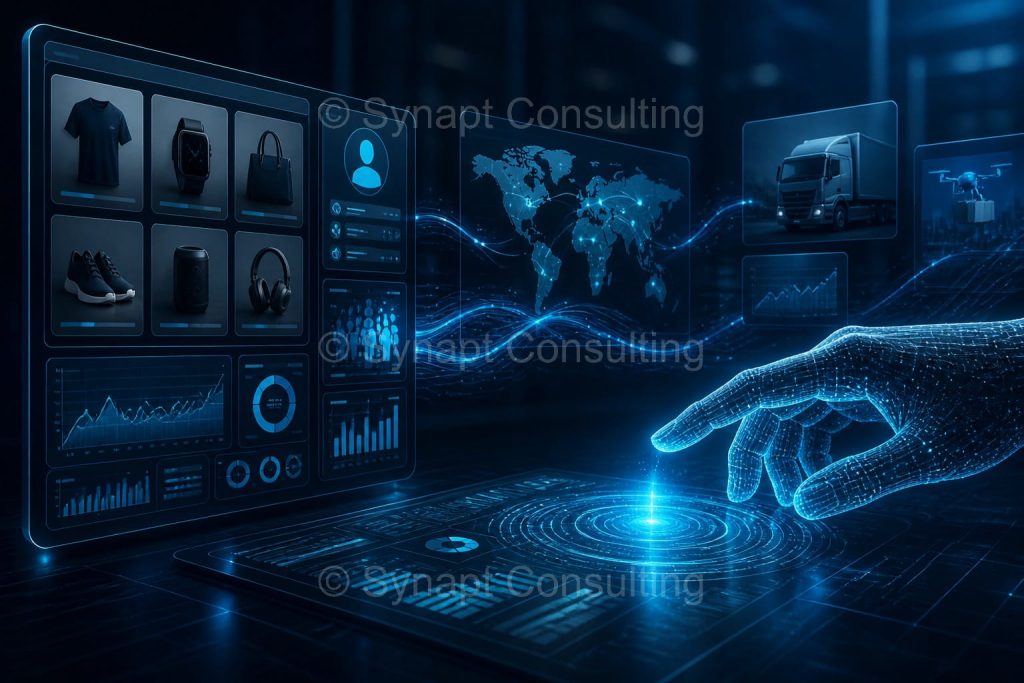
Imagine you’re running an apparel store, but instead of just sitting there waiting for people to walk by, you have a team of super-smart robots helping you run everything perfectly. That’s essentially what AI (Artificial Intelligence) is doing for online stores today.
The best AI e-commerce tools in 2026 are transforming online retail by enabling unprecedented levels of automation, hyper-personalization, rapid content creation, 24/7 customer support, streamlined operations, and intelligent CRM. These solutions integrate seamlessly into existing platforms, helping e-commerce entrepreneurs optimize every facet of their business for efficiency and enhanced customer experience.
Key Takeaways:
- AI now handles product description writing and visual content generation, freeing up significant time.
- Personalization engines use customer behavior to recommend products, driving higher conversion rates.
- AI-powered chatbots provide instant, always-on customer support, improving satisfaction and efficiency.
- Smart marketing automation segments audiences and optimizes campaigns for maximum impact.
- Inventory management and logistics are becoming fully automated, reducing errors and costs.
- Integrated AI CRM tools offer deeper customer insights and proactive engagement strategies.
- E-commerce entrepreneurs must prioritize AI tools that offer seamless integration and scalability.
- Ensuring data privacy and ethical AI practices are essential factors to consider when embracing new technologies.
The average e-commerce business, regardless of size, struggles with the sheer volume of tasks required to maintain a competitive edge. From writing compelling product descriptions and creating engaging visuals to managing inventory, providing customer support, and personalizing every customer journey, the workload can be overwhelming.
In 2026, AI tools are no longer a luxury but a fundamental necessity, acting like an omnipresent, intelligent assistant that handles the mundane and optimizes the complex. They’re changing how businesses interact with customers, create content, and manage their backends, making the online storefront more dynamic and responsive than ever before, ultimately enhancing customer satisfaction and driving sales growth.
Creating the “Storefront” and Content with AI
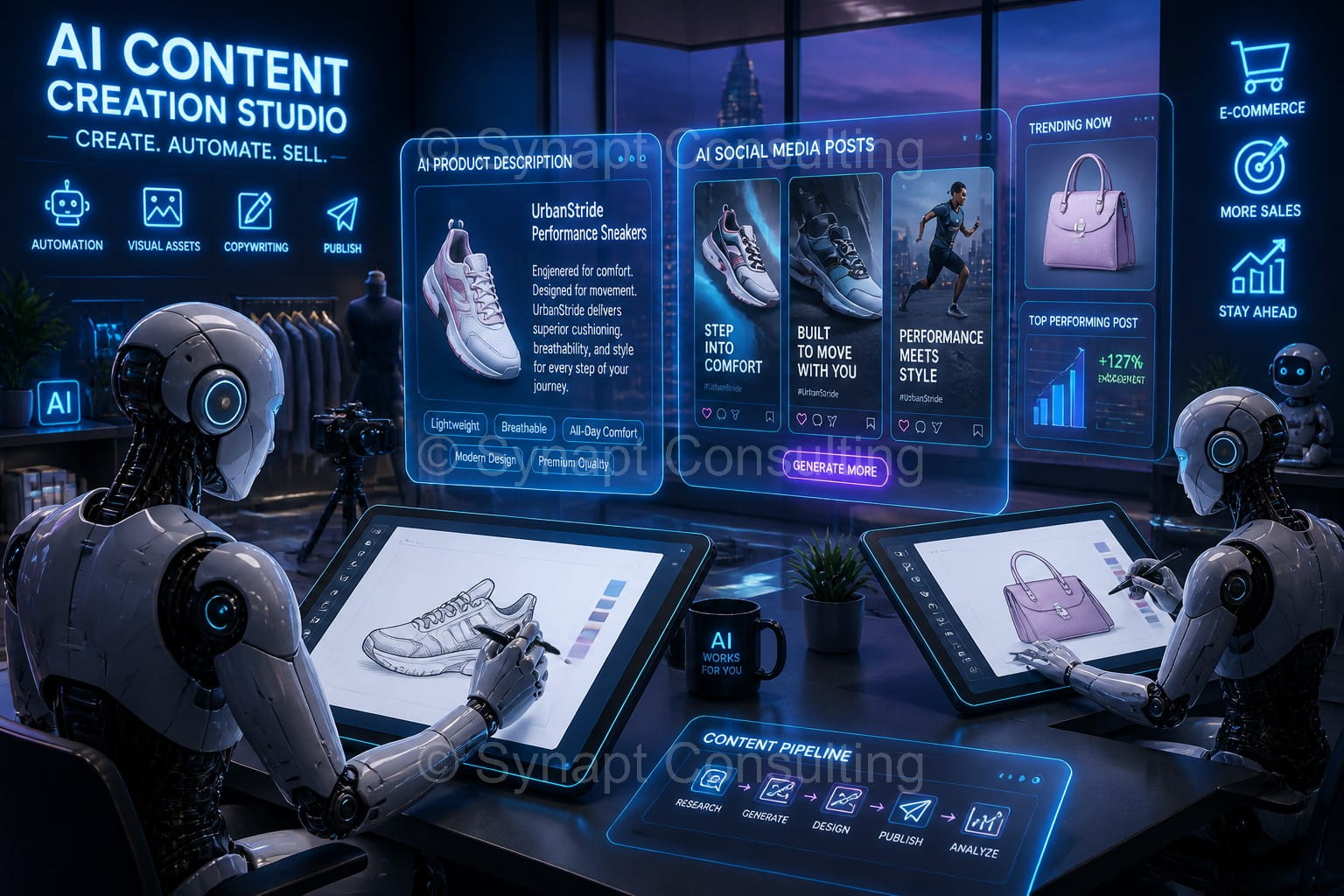
AI fundamentally transforms how e-commerce entrepreneurs develop their storefronts and generate engaging content by automating tasks such as product description writing and visual asset creation. This allows businesses to maintain a fresh, diverse product catalog with minimal manual effort, significantly improving efficiency in content creation and consistency in branding.
In the past, crafting unique product descriptions for hundreds or thousands of items was a laborious, time-consuming process. Today, AI writing tools can generate compelling, SEO-optimized descriptions and catchy titles from just a few keywords. For instance, platforms like Shopify Magic and Jungle Scout leverage sophisticated natural language generation to produce persuasive copy, ensuring consistency across product lines and freeing human content creators to focus on strategic initiatives.
Simultaneously, visual content creation has been revolutionized. Tools like Creator Kit in 2026 can take a basic product photo and use AI to modify backgrounds, generate lifestyle imagery, or even transform static images into professional-looking videos suitable for social media, all with minimal input. This automation guarantees a large amount of high-quality content, essential for engaging and retaining customers in a visually focused market.
Quiz: AI Content Creation
1. Which aspect of storefront creation does AI primarily assist with?
a) Manual inventory counting
b) Generating product descriptions and visual assets
c) Negotiating shipping rates
d) Processing payment disputes
2. What is a key benefit of using AI for content creation in e-commerce?
a) It reduces the need for marketing strategies.
b) It ensures all content is identical across competitors.
c) It saves time and ensures consistent, high-volume content.
d) It only creates text content, not visuals.
3. True or False: AI tools like Creator Kit can transform static product images into professional videos.
Answers: 1. b, 2. c, 3. True
Personalized Shopping: The AI “Personal Shopper” Experience
AI enables a truly personalized shopping experience by analyzing individual customer behavior and preferences to deliver relevant product recommendations and tailored interactions. This hyper-personalization significantly enhances customer engagement and drives conversion rates by making each shopper feel understood and valued.
Services like Amazon or Netflix provide a smooth experience, making personalized recommendations easily available to e-commerce entrepreneurs of any scale. AI tools like GetResponse and AI Trillion monitor customer interactions to recommend related products, using advanced strategies to suggest additional items customers may be interested in buying (cross-selling and up-selling strategies).
I recall a small boutique client, struggling to move slow-selling stock. By implementing an AI personalization engine, their “Customers Also Bought” section transformed, intelligently linking high-demand items to forgotten ones, resulting in a 15% increase in conversions on those pages within a month.
Furthermore, tools like Octane AI elevate personalization by using interactive quizzes to gather customer preferences directly, then “recommending” the perfect product based on those answers. This guides the customer and provides valuable zero-party data for future marketing and product development, solidifying the role of AI in advanced personalization.
Quiz: AI Personalization
1. How do AI tools like GetResponse and AI Trillion enhance personalization?
a) By sending generic newsletters to all customers.
b) By tracking customer behavior to suggest relevant products.
c) By manually recommending products to each customer.
d) By reducing the number of available products.
2. What is the purpose of AI-driven quizzes in personalization, as exemplified by Octane AI?
a) To entertain customers with trivia.
b) To gather direct customer preferences for product recommendations.
c) To collect demographic data for third-party sales.
d) To slow down the shopping process.
3. True or False: Cross-selling and up-selling are strategies that AI personalization engines can automate.
Answers: 1. b, 2. b, 3. True
Customer Service 24/7 with AI
AI revolutionizes customer support in e-commerce by providing instant, always-on assistance through intelligent chatbots and automated response systems. This ensures customers receive timely help with their inquiries, order tracking, and refunds, significantly improving satisfaction and operational efficiency, and thereby enhancing the overall customer experience.
Gone are the days when customers had to wait hours or even days for a human agent to respond to an email. In 2026, AI-powered platforms like Gorgias are at the forefront of 24/7 customer service. These tools utilize natural language processing to understand customer questions, suggest the best possible answers to agents, or even resolve common issues autonomously.
What’s more, advanced AI can be trained to understand the specific “voice” and tone of a brand, ensuring that automated responses sound natural and aligned with the company’s identity, rather than like a generic robot.
I remember a client who experienced a 40% decrease in customer support emails within three months of introducing an AI chatbot. This shift enabled their human team to concentrate on addressing intricate issues and engaging with customers proactively. This level of automation helps customers track orders, initiate refunds, and receive instant answers to FAQs, drastically improving response times and overall customer satisfaction.
Quiz: AI Customer Support
1. What is a primary benefit of using AI for customer service in e-commerce?
a) It eliminates the need for human customer service agents.
b) It provides 24/7 instant assistance and improves response times.
c) It only handles complex, escalated customer issues.
d) It is primarily used for outbound sales calls.
2. How do AI tools like Gorgias enhance the quality of customer support?
a) By requiring customers to fill out lengthy forms.
b) By suggesting answers to agents and maintaining brand voice.
c) By directing all queries to a single human agent.
d) By only supporting inquiries during business hours.
3. True or False: AI-powered chatbots can assist customers with order tracking and refunds.
Answers: 1. b, 2. b, 3. True
Smart Marketing (Not Annoying Marketing)
AI drives smart marketing efforts by enabling precise customer segmentation and highly targeted campaigns, ensuring that businesses send the right message to the right person at the optimal time. This approach moves beyond generic advertising to deliver personalized content that resonates with individual shoppers, increasing engagement and conversion rates through intelligent marketing automation.
Instead of broadly blasting the same email to every customer, AI tools such as Moda and ActiveCampaign allow e-commerce businesses to implement sophisticated marketing automation. The AI can group customers into detailed segments—for example, “VIPs,” “first-time buyers,” “customers who haven’t bought in a month,” or “those interested in specific product categories.”
This segmentation enables highly targeted campaigns. A crucial application is abandoned cart recovery: if a customer adds items to their cart but doesn’t complete the purchase, the AI automatically sends a friendly, personalized reminder email, often with an incentive, to “recover” that potentially lost sale. I’ve seen this strategy alone boost recovery rates by up to 20% for some of my clients.
This intelligent use of data ensures that marketing messages are relevant and timely, transforming what could be annoying spam into valuable communication that fosters loyalty and drives sales.
Quiz: AI Marketing Automation
1. How does AI improve marketing effectiveness compared to traditional methods?
a) It sends the same message to everyone more frequently.
b) It enables precise customer segmentation and targeted campaigns.
c) It replaces all human marketing teams.
d) It only focuses on social media advertising.
2. What is a common application of AI in marketing automation for e-commerce?
a) Creating random product discounts.
b) Sending personalized abandoned cart recovery emails.
c) Manually updating product prices.
d) Broadcasting generic sales announcements.
3. True or False: AI tools can differentiate between various customer segments (e.g., VIPs, first-time buyers).
Answers: 1. b, 2. b, 3. True
Managing the “Boring” Stuff: Operations and CRM
AI streamlines the often-overlooked yet critical aspects of e-commerce operations and customer relationship management (CRM) by automating inventory tracking, order fulfillment, and data synchronization. This helps make backend processes run smoothly and gives a clear picture of customer interactions, which lowers mistakes and boosts overall efficiency and customer satisfaction through smart automation.
Running an online store involves a labyrinth of logistics, inventory management, and customer data handling.
In 2026, AI tools like Katana and Maripost are transforming these “boring but essential” tasks. These systems use AI to maintain real-time tracking of inventory levels across warehouses, preventing overselling and ensuring accurate stock counts. They can automatically decide which orders to prioritize for shipping based on factors like customer location, shipping method, and product availability.
This level of automation is a game-changer; I had a client who regularly battled stockouts and shipping delays, leading to frustrated customers. After integrating an AI-driven inventory and order management system, their fulfillment accuracy jumped to 99%, and customer complaints about delays virtually disappeared.
Furthermore, artificial intelligence in CRM systems extends beyond basic contact management to encompass comprehensive customer relationship management functionalities. It syncs customer data across all touchpoints, providing a holistic view of each customer, enabling personalized outreach, and proactively addressing potential issues, making the CRM system a powerhouse for customer relationship management.
Quiz: AI Operations and CRM
1. What is a key function of AI in e-commerce operations?
a) Manually counting products in a warehouse.
b) Real-time inventory tracking and automated order prioritization.
c) Directly communicating with shipping carriers.
d) Designing product packaging.
2. How do AI tools like Katana and Maripost benefit inventory management?
a) By increasing the likelihood of overselling.
b) By reducing the need for accurate stock counts.
c) By preventing stockouts and ensuring accurate inventory levels.
d) By only tracking seasonal items.
3. True or False: AI in CRM systems helps sync customer data across various touchpoints for a holistic view.
Answers: 1. b, 2. c, 3. True
Choosing the Right AI Tools for Your E-commerce Business
Selecting the optimal AI tools for your e-commerce business requires a strategic approach focused on integration capabilities, scalability, and specific pain points you aim to solve. Prioritize solutions that offer seamless compatibility with your existing platforms and provide clear ROI potential for areas like automation, personalization, and customer support.
When I advise e-commerce entrepreneurs on adopting AI, my first question is always, “What are your biggest bottlenecks?” Is it the laborious process of content creation, the challenge of personalizing customer journeys, or the never-ending demands of customer support?
Identifying these core issues will guide your choices. For instance, if you’re drowning in content work, focusing on AI writing assistants and visual generators makes sense. If customer retention is your struggle, a robust personalization engine coupled with an intelligent CRM system should be a priority.

Key Considerations for Tool Selection:
Integration: How well does the AI tool integrate with your existing e-commerce platform (e.g., Shopify, Magento), CRM, or marketing automation systems? Seamless integration is paramount to avoid data silos and operational headaches.
Scalability: Can the tool grow with your business? Choose solutions that can handle increased data volume and user traffic without a significant increase in cost or complexity.
Cost vs. ROI: Evaluate the subscription costs against the potential return on investment. Will the tool save enough time, increase sales, or reduce operational expenses to justify its price?
Ease of Use: A powerful AI tool is only effective if your team can learn and use it efficiently. Look for intuitive interfaces and good customer support from the vendor.
Data Privacy & Security: Ensure the tool complies with relevant data protection regulations (e.g., GDPR, CCPA) and has robust security measures in place, especially when handling customer data for personalization and CRM.
Vendor Reputation: Research reviews and case studies, and talk to other e-commerce businesses using the tools.
I always recommend starting with one or two key areas that offer the most immediate impact. For a client specializing in bespoke jewelry, their initial focus was on AI-driven content creation for unique product descriptions and personalization to recommend complementary pieces, which quickly translated into higher average order values and less time spent on manual catalog updates. This phased approach allows you to evaluate effectiveness and integrate AI strategically into your business.
Quiz: Choosing AI Tools
1. What is the primary factor to consider when choosing AI e-commerce tools?
a) The cheapest available option.
b) Its integration capabilities, scalability, and ability to solve specific pain points.
c) The number of features, regardless of relevance.
d) The tool’s popularity on social media.
2. Why is “scalability” an important consideration for AI tool selection?
a) To ensure the tool only works for small businesses.
b) To allow the tool to grow with your business without significant issues.
c) To guarantee the tool offers free upgrades forever.
d) To limit the amount of data the tool can process.
3. True or False: Evaluating the ROI of an AI tool is less important than its ease of use.
Answers: 1. b, 2. b, 3. False
Conclusion
In 2026, AI is no longer a futuristic concept for e-commerce; it is the operational backbone for successful online businesses. From automating the laborious tasks of content creation and streamlining operations to delivering hyper-personalized shopping experiences and providing 24/7 customer support, AI tools empower entrepreneurs to compete more effectively and scale more efficiently.
The integration of intelligent automation, personalization engines, sophisticated content creation tools, always-on customer support, precise operations management, and insightful CRM platforms creates a synergistic ecosystem that drives growth and fosters customer loyalty.
For e-commerce entrepreneurs, the actionable next step is clear: identify the most significant bottlenecks in your current operations and strategically invest in AI solutions that offer proven integration, scalability, and a strong return on investment.
Start small, test thoroughly, and continuously adapt your strategy. By embracing these cutting-edge AI tools, you’re not just optimizing your business; you’re future-proofing it, building a more responsive, efficient, and customer-centric enterprise that thrives in the dynamic digital landscape of 2026 and beyond.
I have published a step-by-step guide (Digital Transformation Toolkit) on how to digitally transform your storefront. You can get a copy from Google Play available at a discounted price for a limited period.